
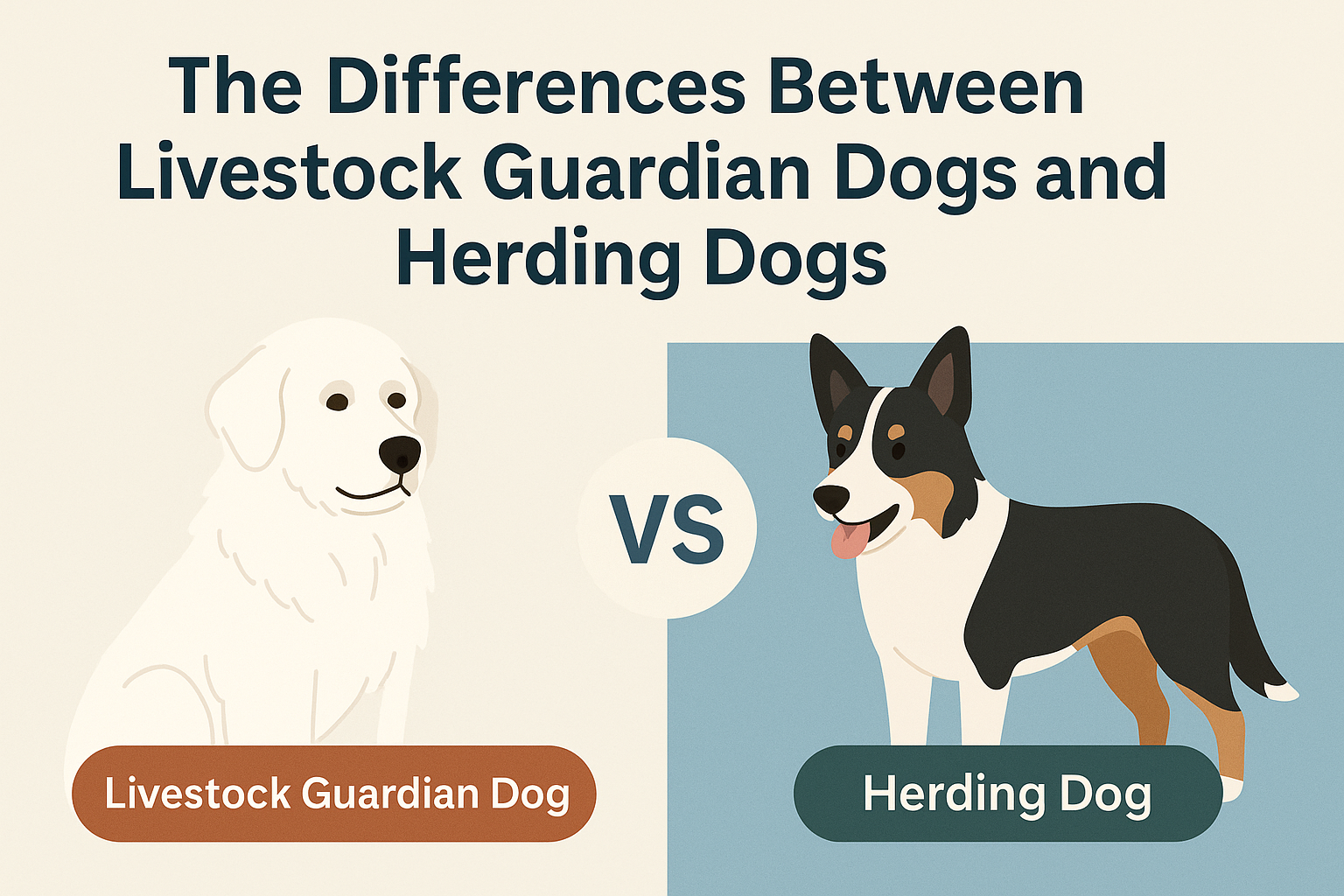
The Difference Between Livestock Guardian Dogs and Herding Dogs
When it comes to working farm dogs, it’s important to understand the roles that livestock guardian dogs (LGDs) and herding dogs play. While both are incredibly valuable on a farm, they serve very different purposes—and knowing which one you need can make all the difference.
🐕 Herding Dogs: The Managers
Herding dogs like Border Collies, Australian Shepherds, and Heelers are bred to move livestock. These dogs work under human direction to guide animals from one place to another—whether that’s shifting sheep to a new pasture or rounding up cattle for health checks.
They’re:
-
Highly trainable
-
Focused and fast
-
Eager to work closely with people
These dogs are full of energy and need both physical exercise and mental stimulation. If they don’t have a job, they’ll find one… and it’s not always what you’d want.
One of the key traits that sets herding dogs apart is their modified prey drive—a natural instinct that’s been fine-tuned over generations.
In the wild, a prey drive involves a sequence: stalk → chase → grab → kill. Herding dogs have been selectively bred to keep only the first parts of that sequence—stalk, chase, and sometimes nip—but without the intent to harm. This is what allows them to move livestock effectively.
You’ll often see a herding dog crouch low, stare intensely, and circle around a group of animals—these are classic stalking behaviors, and they’re deeply instinctual.
🛡️ Livestock Guardian Dogs: The Protectors
Livestock guardian dogs—such as Great Pyrenees, Maremmas, Anatolian Shepherds, and Akbash—serve a totally different role. Rather than herding animals, LGDs live among the livestock and protect them from predators.
They’re:
-
Calm and independent
-
Bonded with their herd
-
Always alert, even when they seem relaxed
Unlike herding dogs, LGDs work without human direction. They make decisions on their own, often covering large areas to monitor and guard the herd.
Additionally, LGDs aren’t motivated by prey drive. Instead, they’re driven by a deep-rooted protective instinct—a trait that’s been intentionally bred into them for thousands of years.
LGDs bond closely with the animals they’re raised with, whether it’s sheep, goats, or alpacas. Once that bond is established, their instinct is to watch over and defend their “family” from anything that seems like a threat.
They use their presence, scent, and voice—lots of barking—to deter predators before a confrontation ever happens. They will fight if needed, however most threats are scared off long before it comes to that.
🔍 Quick Comparison
| Herding Dogs | Livestock Guardian Dogs | |
|---|---|---|
| Primary Role | Move/control livestock | Protect livestock from predators |
| Style | Works closely with humans | Works independently |
| Temperament | High energy, responsive | Calm, watchful, self-reliant |
| Living Situation | Lives with people | Lives with livestock |
| Training Focus | Obedience and control | Bonding and territory awareness |
🐾 Which One is Right for You?
The right dog depends on your setup:
-
If you need help moving livestock, a herding dog is your best bet.
-
If you need protection from predators, a livestock guardian dog is ideal.
-
And if you have both needs? You might want LGDs and herding dogs—just be sure to train the dogs together. You don’t want your LGD thinking your herding dog is a predator!
They each bring something totally different to the table—and when they’re doing what they’re built to do, it’s a beautiful thing to watch.
Understanding the difference between these two types of working dogs ensures each one is set up for success—leading to a more peaceful farm.
Leave a Reply